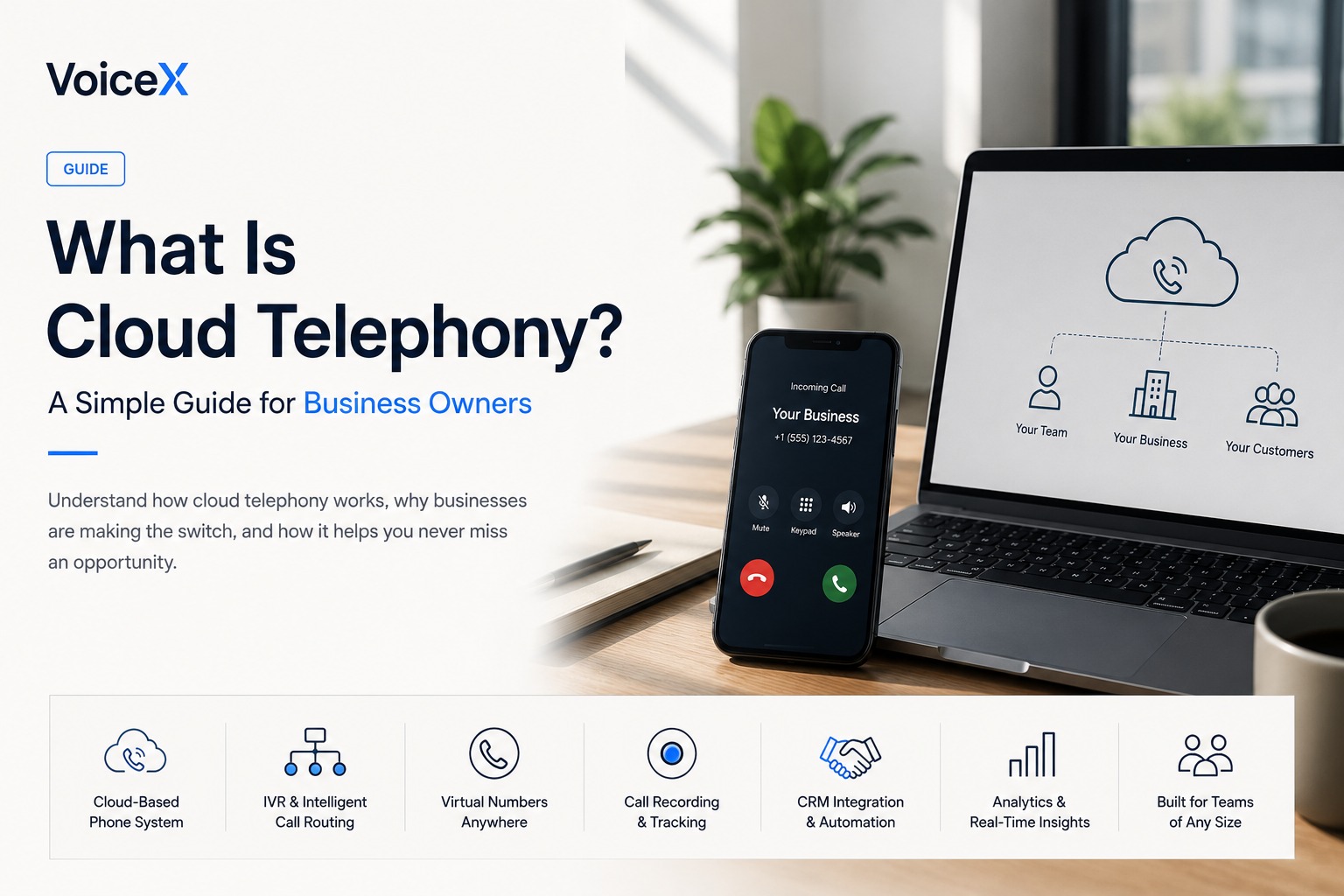

Learn what cloud telephony is, how it works, why businesses are replacing traditional phone systems, and how modern business communication helps you never miss an opportunity.
you've probably come across a lot of technical jargon. The good news? Cloud telephony is much simpler than it sounds. Let's break it down.
Cloud telephony is a business phone system that operates over the internet instead of traditional telephone lines.
Instead of installing expensive hardware inside your office, your communication system is securely managed in the cloud.
The word "cloud" simply means the technology is hosted online rather than inside your office, allowing your business communication platform to work from virtually anywhere.
With cloud telephony, one business number can help your team answer more customer calls, automatically direct callers to the right people, keep track of conversations, and stay connected whether employees are in the office or working remotely.
Behind the scenes, this is powered by technologies such as intelligent call routing, virtual numbers, call recording, CRM integration, and missed-call tracking.
The result is a communication system that grows with your business instead of holding it back.
Imagine you own a busy restaurant. Every customer enters through one main entrance. A host welcomes them. Some are guided to indoor seating. Others prefer the terrace. Large groups are directed to bigger tables. Reservations go to a different queue. Customers don't need to know how the restaurant works behind the scenes. They simply expect to be guided to the right place. Cloud telephony works in much the same way. Every customer calls one business number. Behind the scenes, the system automatically directs each caller to the right employee or department. Simple. Professional. Efficient.
For many businesses, a personal mobile number works in the beginning. Until the business starts growing. That's when the limitations begin to appear. Customers call while you're already helping another customer. You're in a meeting. Driving. Visiting a client. Managing your store. Your employees can't answer each other's calls. Customer conversations aren't recorded. Missed calls go unnoticed. Leads disappear without anyone realizing it. A personal phone was designed for one person. A business phone system was designed for an entire business.
You've probably heard something like this when calling a company:
That's an Interactive Voice Response (IVR).
Instead of every customer reaching the same person, an IVR guides callers to the department they actually need.
A good IVR helps businesses:
- Respond faster
- Reduce unnecessary call transfers
- Create a professional first impression
- Improve customer experience
IVR is one of the technologies that makes cloud telephony so effective.
Traditional phone systems were built for businesses where everyone worked from the same office.
Modern businesses don't work that way anymore.
Teams work remotely.
Salespeople travel.
Support teams work in shifts.
Business owners juggle multiple responsibilities.
Customers expect faster responses than ever before.
Cloud telephony adapts to the way businesses operate today instead of forcing businesses to adapt to outdated technology.
Instead of forcing your team to work around the phone system, cloud telephony allows the phone system to work around your business.
The best communication software doesn't win because it has the longest feature list. It wins because it solves everyday business problems. A modern business communication platform should help you:
These outcomes are typically powered by technologies such as IVR, intelligent call routing, virtual numbers, CRM integration, call recording, analytics, role-based access, and real-time reporting. The technology matters. But the business outcome matters even more.
Not anymore. Modern cloud telephony platforms are designed for businesses of every size. Whether you're:
cloud telephony provides enterprise-grade communication capabilities without requiring enterprise-sized infrastructure or operational costs. As businesses grow, these platforms can also support agencies, service providers, and software companies that want to deliver communication services under their own brand—a topic we'll explore later in this series.
For many customers, your phone is the very first experience they have with your business. Every unanswered call creates uncertainty. Every missed conversation could become a lost customer. Cloud telephony isn't simply about replacing traditional phone lines. It's about helping businesses become easier to reach, easier to manage, and better equipped to serve customers wherever work happens. Because the businesses that grow aren't always the ones with the biggest marketing budgets. They're often the ones that make themselves the easiest to reach.